
In this article
When people talk about Meta Ads, one of the most frequent questions is always the same: how many creatives do you need?
It is a useful question, but an incomplete one. The number of active assets says little if those creatives all communicate the same idea with minimal variations.
Changing a color, a sentence or a piece of music can raise the number of ads in the account, but not necessarily the number of genuinely different signals you are giving the system. With Andromeda, the point becomes building alternatives different enough for Meta to better tell apart messages, motivations and people.
The problem is not how many creatives you have
For a long time the creative process was fairly linear: find a winning asset, scale it and produce more versions of it.
You changed the color of an element, the text, the music or some detail of the edit. The conceptual structure of the ad, however, stayed the same.
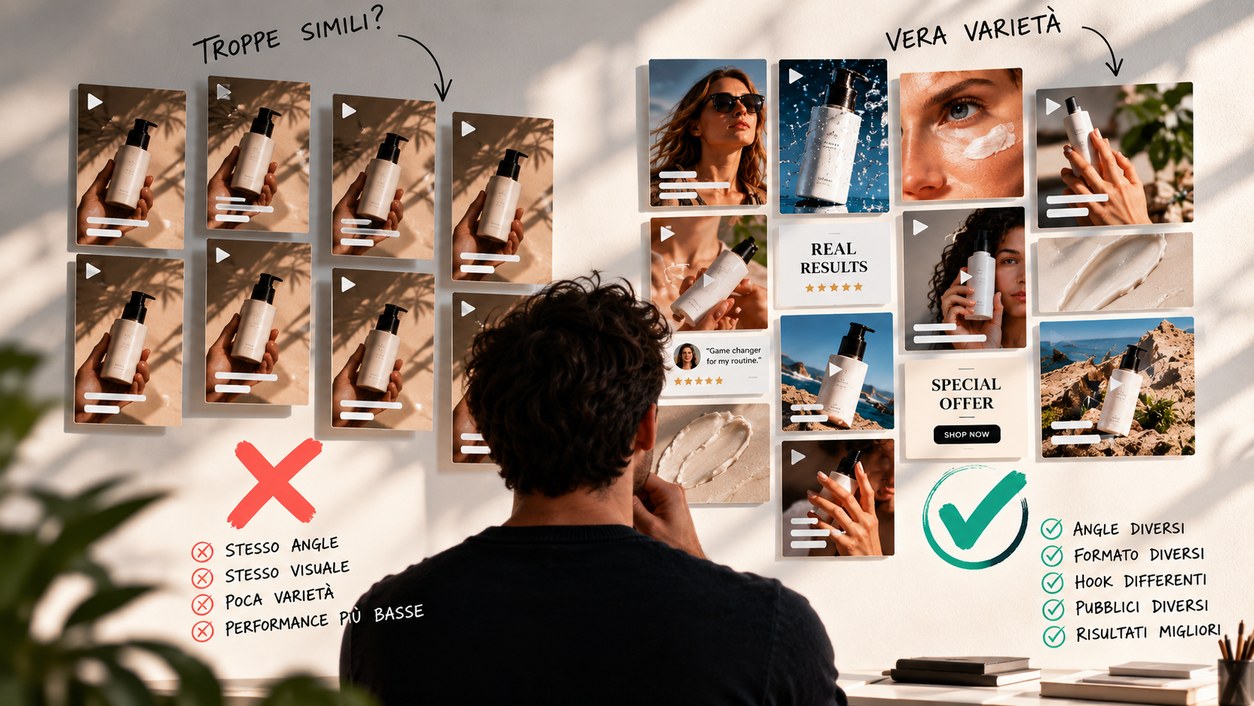
This approach is less effective today because Meta’s delivery system needs to be able to compare genuinely different alternatives. If twenty ads say essentially the same thing, the volume goes up but the variety of the signal stays limited.
More ads does not mean more variety
The important distinction is therefore not between few and many creatives, but between micro-variations and real variations.
Micro-variation vs real variation
Micro-variation
- Color change
- Font change
- Small text edit
- Different music
- The same idea in a different dress
Real variation
- New creative angle
- New type of creator
- New format
- Different pacing
- New psychological lever in the hook
The difference is simple: in the first case the execution changes. In the second, at least in part, the reason someone should stop and pay attention changes.
Creative becomes part of the targeting
Every creative sends a different signal
One of the most important changes is exactly this: creative is not only there to turn impressions into clicks or conversions.
The content of the ad itself helps tell Meta who might be interested in that message.
A creative built around a problem speaks to a different person than one built on aspiration. An authoritative creator generates a different perception than a more spontaneous, everyday one. A testimonial and a POV do not present the same message in the same context.
That is why two ads for the same product can serve very different functions even without changing the targeting set in the ad set.
If, on the contrary, all the creatives are visually and conceptually very similar, the variety of signals the system can interpret shrinks as well.
What changes in how ads are designed
Before
- More explicit segmentation
- Variants of the same idea
- Optimizing the winning creative
Today
- Creatives designed for different motivations
- More distinct signals
- Greater conceptual variety across assets
What real diversification means
The most useful criterion is this: a true variant should change the reason the user stops on the ad.
So replacing a sentence while keeping the same lever is not enough. Changing a graphic element is not enough. There are five levels on which to build more meaningful diversification.
The 5 levels of creative diversification
Creative angle
The same product can be told starting from different motivations.
For example:
- solution to a problem
- aspiration
- transformation
- social proof
The product stays the same, but the reason someone should want it changes.
Type of creator
The creator does not only change the look of the ad.
Someone perceived as authoritative communicates differently from someone who conveys more spontaneity, closeness or everyday life.
Changing who carries the message can therefore mean speaking to different sensibilities.
Format
UGC, demo, vlog, POV, testimonial, voice over and carousel are not simply different ways of laying out the same content.
Each format creates a different context and is recognized differently by the user.
Pacing and energy
The way the content is built also changes the kind of experience.
A fast, information-dense edit does not communicate in the same way as a slower, more emotional narrative.
Hook
Changing the hook does not necessarily mean changing a few words.
The real difference comes when the psychological lever changes.
Among the possible levers:
- shock
- identification
- confession
- authority
- FOMO
- transformation
If only the wording changes while the mechanism meant to capture attention stays the same, the variation remains superficial.
How to build a creative system in practice
Start from angles, not from the number of ads
Once it is clear what diversifying means, the next step is to turn the principle into an operating process.
A good starting point is 3-5 genuinely distinct creative angles per product. Not five versions of the same concept, but five possible perspectives built around different motivations, emotions or people.
For each angle you then work on different hooks, creators and formats.
A simple operating framework
- 1
Define 3-5 genuinely distinct angles
Start from the motivation you want to intercept, not from the asset you want to produce. Each angle should present the product from a perspective different enough from the others.
- 2
Develop 2 hooks for each angle
Do not just rewrite the same sentence. If possible, change the lever used to win attention.
- 3
Bring in different creators
The same angle can take on a different meaning depending on who communicates it. Authority, spontaneity and closeness do not necessarily produce the same perception.
- 4
Vary the format
UGC, demo, POV, testimonial or carousel can change even the context in which the message is received.
- 5
Put different signals into circulation
The initial goal does not have to be finding a single winning creative right away. First you need to give the system alternatives different enough to explore.
This does not mean every account should automatically develop every possible combination. The framework is mainly about changing the criterion used to think about creative production: variety of ideas first, volume second.
Building this kind of system means treating creative testing, budget distribution and performance reading as parts of the same Paid Social & Growth process.
So how many creatives do you need?
There is no universal number
There is no universal number. The quantity depends on the budget and the stage of the account. For smaller structures a few genuinely distinct concepts can be enough. For more structured accounts you can reach 15 or more real variants.
The important thing is not to invert the order of decisions. You should not first ask how many ads to produce. You should work out how many different perspectives on the offer are really worth testing.
The two questions to ask before producing more ads
Am I covering genuinely different motivations and people?
If all the assets speak to the same need, with the same lever and in the same way, adding more may increase the volume without increasing the variety.
Would Meta see distinct signals or the same idea repeated?
If the differences are only cosmetic, the creative system may be less diversified than the number of active ads suggests.
Understanding whether an account is really diversifying its creative signals is also one of the things to look at when analyzing the structure of a Meta Ads Audit in depth.
From creative production to creative system
The most interesting change is therefore not about the number of videos, images or ads to deliver, but about how the whole process is thought through.
Every creative can be treated as a different hypothesis about what moves a person: a problem, a desire, a motivation or a different reading of the offer. From this point of view, creative work moves away from simply producing assets and closer to building a system able to generate different signals and learnings.
A useful creative is not simply another asset to add to the account. It is a different hypothesis about what can move someone to act.
FAQ
How many creatives do you need for a Meta Ads campaign?
There is no fixed number. Smaller accounts may need only a few genuinely distinct concepts, while more structured accounts can reach 15 or more real variants. The priority remains the diversity of the signals, not the absolute number of ads.
Does changing the hook mean creating a new variant?
Not necessarily. If only the wording changes while the psychological lever stays the same, the variation remains essentially weak. A more meaningful difference comes when the mechanism used to capture attention changes.
Which elements should you really vary?
The five main levels are: creative angle, type of creator, format, pacing and energy, and hook. The goal is to create alternatives that speak to different motivations and people.