In this article
With Andromeda, creating ten nearly identical versions of the same video by changing only the opening does not necessarily mean creating ten genuinely different creatives.
The point is this: Meta looks for more variety in both message and visuals, so the problem is not simply producing more versions of the same asset. Variance has to be built beforehand, already in the script and in the way the footage is shot.
The advantage is operational. If hook and body are designed as modular components, a single production session can generate many more outputs without having to record every video from scratch.
Why changing only the hook does not create enough variance
For a long time one of the simplest ways to multiply a video ad was to keep almost everything unchanged and change the hook.
Same creator, same body, same edit. The opening changed and a new variant was born.
The limit of this approach is that the difference stays superficial. With Andromeda, modifying only the hook is no longer enough to give video ads real variety. The differentiation has to involve the visuals and the overall message too.
This does not necessarily mean increasing production. It means changing the way production is designed.
Changing the version does not create real variance
Surface variance
- Same video
- Same body
- Same visuals
- Modified hook
- Minimal differences between versions
Structural variance
- Different hooks
- Different messages
- Different visuals
- Recombinable sequences
- Genuinely different edits
Build the hook so you can multiply it
The first lever is the hook.
Instead of recording many different openings separately, it helps to build a longer hook that already contains several communication variants. It can include a question, a statement, a problem or a solution within the same recording.
The goal is not to use that block in full in the final video. It is to create material.
Once recorded, the mega hook can be split in editing and turned into several standalone openings.
Record once, split later
At this stage it does not matter if the recorded hook runs longer than you would normally use in the final ad.
Recording and editing have two different functions.
During recording you want to generate enough material to choose from, cut and recombine. In editing you turn that material into the individual openings you will actually use.
The same communication variant can then change further through visual treatment.
The same message can become four different openings
On camera
The creator speaks directly to the user.
Split screen
The creator stays visible alongside the b-roll.
Green screen
The creator speaks while the supporting content fills the background.
Voiceover + b-roll
The creator’s voice stays, but the video shows supporting footage throughout.
These are four different ways of using the same starting material. The point is not to create four cosmetic copies of the same video, but to have enough flexibility to genuinely change how the message is presented.
The body has to work as a modular system
The same logic has to continue in the central part of the video.
If the body is recorded as a single continuous speech, every scene depends on the one before and the one after. It becomes hard to cut, move or remove a part without compromising the sense.
It is better to think of the body as a series of standalone micro-sequences. Each block should open and close its own message without depending entirely on the others.
This makes the material much more flexible in editing.
Think of scenes as modules, not as a single speech
A poorly modular body follows a rigid logic:
A necessarily leads to B, B is needed to understand C and C is needed to get to D.
If you remove B, everything else loses meaning.
A modular body works differently.
A communicates one point.
B adds another element.
C reinforces or deepens.
D completes the message.
This does not mean the scenes should be disconnected. But they need enough autonomy to be kept, removed or recombined without forcing you to redo the video.
How to design a modular body
- 1
Split the message into micro-sequences
Each sequence should communicate an idea complete enough to stand even without all the other blocks.
- 2
Record the spoken part on camera
It helps to film the complete spoken part. That way you keep both the original video and the audio available to use as a voiceover if needed.
- 3
Plan visual alternatives
A single sequence can stay as it is or be transformed with b-roll, green screen or split screen. Captions and graphic elements can support the message when needed, without overloading the video.
- 4
Build an extended version first
The first version can contain more sequences and more material.
- 5
Remove what the individual variant does not need
In later versions you can remove redundant blocks or those that combine less well with the chosen hook. This is exactly the kind of flexibility the modular structure is meant to create.
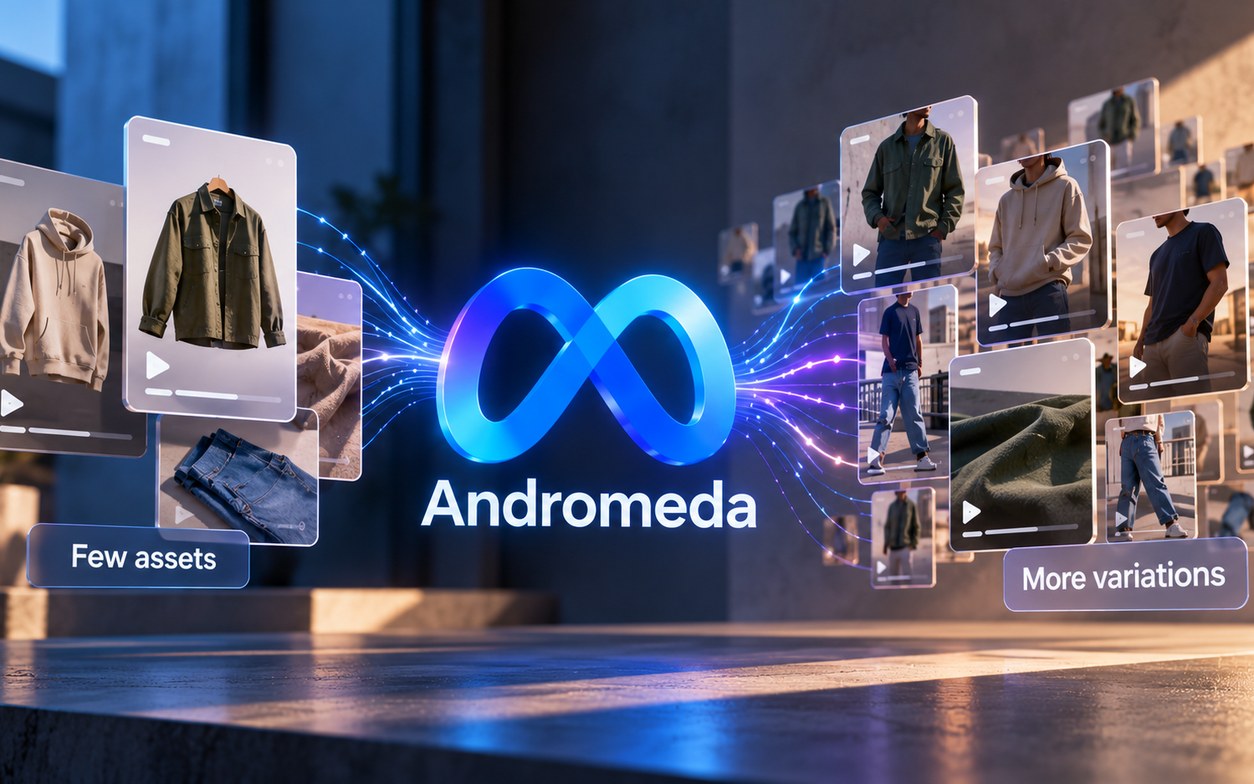
From a few assets to more genuinely different videos
At this point the workflow changes completely.
You are no longer producing a finished video and then trying to derive a few variants from it.
You are creating a system of assets:
- several hooks drawn from the same recording
- several ways of representing each opening visually
- a body made of micro-sequences
- reusable b-roll
- longer or shorter versions of the same message
The CTA is instead the part that can stay more stable. Not all users make it to the end of the video, so this section mainly has the job of prompting the final action.
The potential of the system
The number itself is not the most interesting part: the value lies in the ratio between material produced and ways it can be used.
A recording session designed in a modular way can generate more combinations without forcing you to start from zero each time. And when a variant works, you already have other assets ready to test around the same framework.
Creative efficiency is therefore not about producing less at all costs, but about making sure every asset you record has more ways of being used.