
In this article
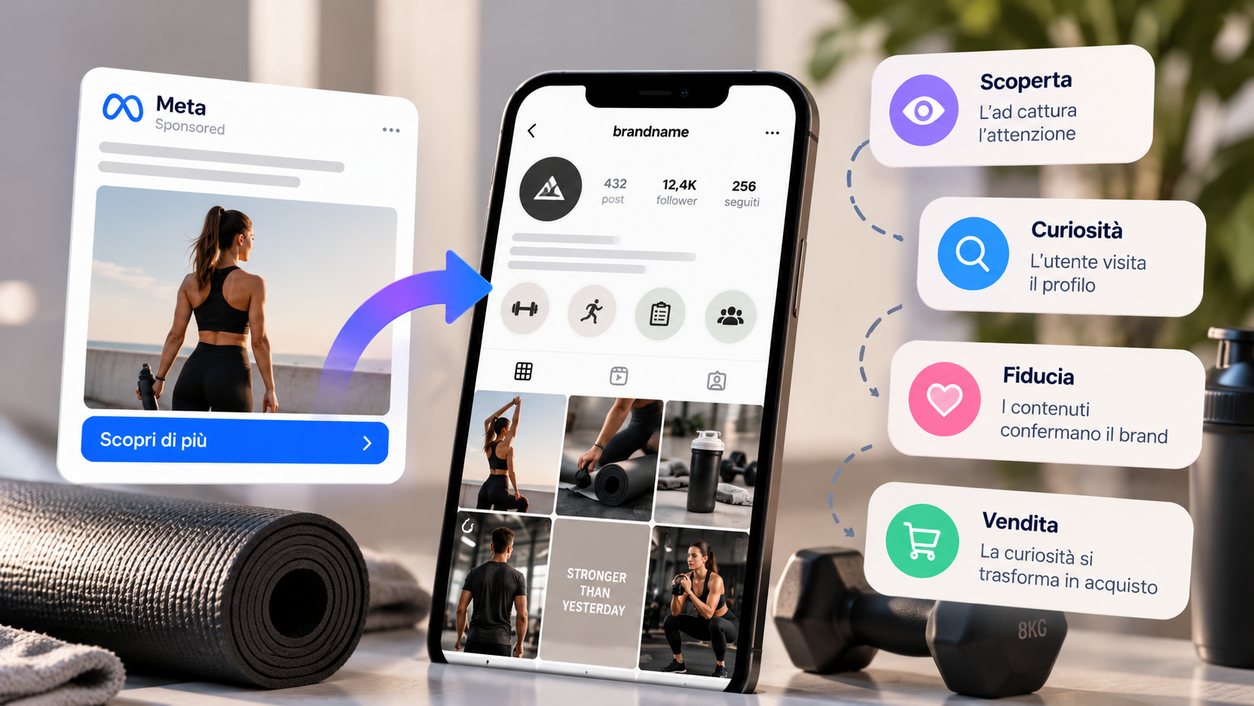
Meta Ads can bring attention to a product, a service or a brand. But the user’s journey does not necessarily stop at the ad.
When something interests them, they may want to understand more about who is behind it, what the brand really offers and whether it is worth exploring further. This is where the Instagram profile or Facebook page can become part of the process.
Thinking of ads as an independent system means missing an important piece of the journey. Advertising can create the first contact, but what a person finds after that contact can contribute to how they evaluate you.
What happens after someone sees a Meta ad
One of the simplest ways to think about advertising is this: I turn on the campaigns, people arrive, I sell. In practice, the journey is less linear.
An ad can attract attention and spark curiosity. At that point an interested person may visit the brand’s social profile to better understand who they are dealing with. They want to see what you publish, how you present the product, what kind of messages you use and whether what they saw in the ad is confirmed in the rest of your online presence.
This does not mean the profile should replace the ads. It means the two are part of the same journey.
Advertising is one of the pieces of the machine. Organic content can help give more context to what the user has just seen.
What users need to find when they land on the profile
A feed made up only of product photos is not always enough to help a person really understand the brand.
Someone who lands on the profile may have very simple doubts.
What a person needs to understand when they visit your profile
- Who is this brand?
- What does it really offer?
- Can I trust it?
- Is it relevant for me?
Organic content should help answer these questions.
This also changes how you should think about the profile. Not only as a shop window for showing products or services, but as a space that helps a person better understand what you are offering.
Before publishing a piece of content, then, it can be useful to start from even more concrete questions:
- What problem does my customer want to solve?
- What doubts do they have before choosing?
- What might hold them back?
- How does my product or service change their situation?
They are simple questions, but they shift the focus from "what do I want to publish" to "what does the person evaluating me need to understand".
How to build organic content that helps your ads too
The principle changes little from one business to another: the content has to help the person better visualize the value of what you are offering.
Lifestyle products
If you sell a product like jewelry, showing it only on a neutral background limits the context.
It can be more useful to show it being worn, in different situations and in settings that help the person imagine how it could fit into their own life.Services
For a service, explaining only what you do may not be enough.
The content can also focus on the transformation the service produces, showing the change it brings to the client’s situation.Technical products
A technical product above all requires clarity.
Explaining in simple words which problem it solves and showing it in a real scenario can help a person grasp its value more quickly.
In all three cases the point is the same: the content should not merely show what you sell. It should help the viewer understand why it might be interesting for them. And it has to do so quickly.
When a person lands on the profile, the attention available is limited. They scroll, compare and can be distracted at any moment. The faster they find answers to their doubts, the better the profile can sustain the interest the ad generated.
Paid and organic, then, are not two separate worlds.
Ads can open the contact. Organic content can help give that contact continuity, showing the brand, the product and the perceived value better.